Guide
Claude in Telegram: how to connect your own Claude subscription to your AI agent

Yes, Claude can work for you inside Telegram, through your own AI agent. On WAM Agents Pro you send /claude, sign in with your Claude account and paste a code back into the chat. After that the agent's requests go to Anthropic on your subscription, and your magnets stay for search and voice. Below: what you need, the four steps, what changes for your data and your bill, and two real tasks from our test agent's chat that you can hand over the same way.
The short answer
You can talk to Claude right inside Telegram through your own AI agent. Your agent on WAM Agents runs on DeepSeek by default. On the Pro plan you send /claude in the chat with your agent, open the link it sends, sign in to your Claude account and send the code back. From then on, the agent's requests go to Anthropic through your account, and Anthropic counts that work against your Claude subscription, not against your magnets.
Nothing else moves. The agent keeps its name, its memory, your files, its skills and its place in your groups and forum topics. /model picks the Claude model, /effort sets how deeply it reasons, and /deepseek takes you back to the default whenever you like.
What you need before you start
Two subscriptions, one for each side of the connection.
- WAM Agents Pro. Pro adds your own model to the agent. It costs $13.90 a month with 400 , or $1.39 for the first month if you subscribe within 7 days of signing up. Free keeps working on DeepSeek, with 200 in the first month and 100 every month after.
- Your own Claude subscription. You sign in with it, and Anthropic bills the model work to it. On Anthropic's pricing page, checked on 30 October 2026, Pro costs $20 a month, or $17 a month billed yearly ($200 up front), and Max starts at $100 a month with 5x or 20x more usage than Pro.
If you pay for ChatGPT rather than Claude, the same slot takes Codex: /codex connects it with a device code right in the chat, and /model then lists the models of your ChatGPT plan.
How to connect Claude in four steps
This is the whole procedure as the Guide and the FAQ describe it on 30 October 2026.
- Send
/claudein the chat with your agent. - Open the link the bot sends. It leads to Claude's sign-in page, where Anthropic asks you to authorise your agent.
- Sign in to your Claude account with the subscription you pay for and confirm. You get a code.
- Send that code back to the chat. The agent confirms: “Claude connected and activated. Switch models with /model.”
After that, a handful of commands cover everything you will need:
/modelopens a picker that loads the live Claude model catalogue, so newly available models appear without waiting for an update./effortsets the reasoning depth for Claude and Codex, from low to max./settingsshows the provider, the model and the reasoning level, with buttons./statusshows which provider is active and whether Claude is connected./loginrefreshes the sign-in later;/logoutdisconnects your provider after a double confirmation within 60 seconds./deepseekreturns to the default model. The agent remembers the model for each topic, and switching back is one tap.
You can save more than one Claude sign-in. If one of them reaches its usage limit, the agent tries the next one and repeats the reply.
What changes after you connect
Where the requests go
Before: through DeepSeek's infrastructure in the People's Republic of China, which every user confirms during onboarding. After: to Anthropic, through your own account and under Anthropic's terms. This is also the answer for anyone who wants to keep their requests away from servers in China.
Who pays for what
The model work is billed by Anthropic to your Claude plan: the heavy work runs on your own sign-in and does not touch your magnets. Everything else in the agent, such as web search and voice transcription, keeps running on magnets at the same rates.
How long a document can be
With your own model, the size of a document the agent can work with is set by the model's context window, not by a page count. That is why the FAQ recommends Claude or Codex for the deepest reasoning and for long documents.
What stays the same
Your chat history, memory and files live in your agent's isolated container, and only your agent has access to it. The agent's name, skills, groups and topics stay as they were. WAM Agents does not use your content to train models (Terms, 9.4); with Claude connected, the requests also fall under Anthropic's own terms for your account.
What you skip
You need no API key, no server and no code: the connection is a sign-in, and it lives in the same Telegram chat as everything else.
Two real tasks to hand over
What do you actually hand over once the agent runs on a stronger model? Below are two tasks from our test agent's chat, sent on 30 October 2026. They ran on the default model, DeepSeek, and the replies are quoted as they came. With Claude connected, you send exactly the same messages, and the model work goes to Claude on your subscription. The person, the channel and the numbers are made up; the answers are real.
Task 1. A channel export: when to post and what
The setup: a home-baking channel in Telegram, 89 posts from July to September in a CSV file with the date, time, type of post, views, reactions and forwards. The question every channel owner asks: when and what to post. The trick is to make the agent do arithmetic, not impressions, so the message asks for a script.
The answer came 47 seconds after the message, and the chart four seconds later. We checked every figure against the file with our own script: the averages, the 36 evening and 36 midday posts, the 2,521 for Sunday evenings and the forwards per post all match.
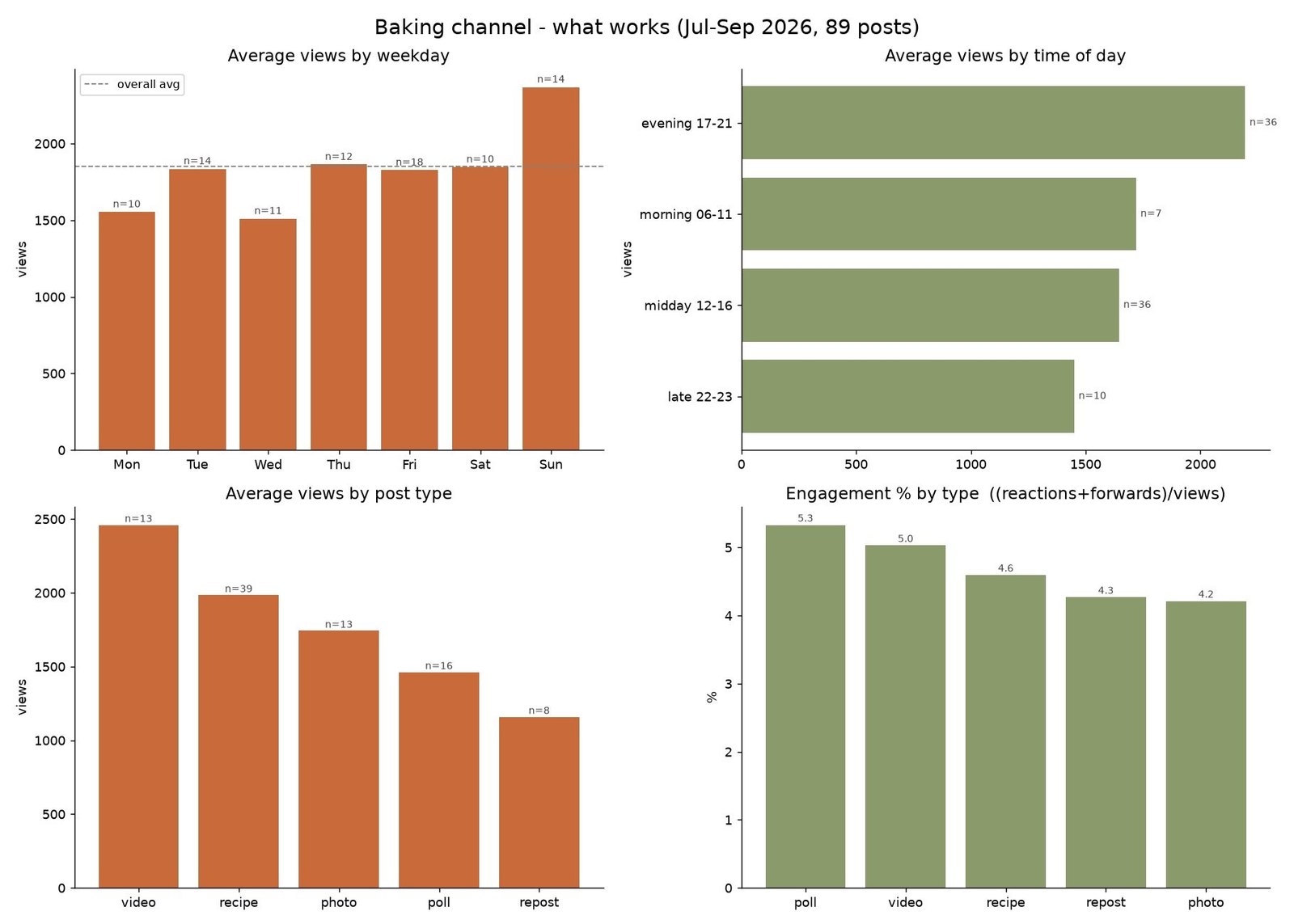
Two things make this answer useful beyond the numbers. The agent counted how many posts stand behind each average and said where the sample is thin, so you know which conclusions to lean on. And the plan is concrete: five slots with dates, a format for each and the reason next to it. The script stays in the agent's workspace, so next quarter you send a new export and ask to run the same analysis.
Task 2. A decision with numbers: two offers for baking classes
The second task is the kind of question where a stronger model earns its keep: two offers, a fixed cost against a percentage, and a decision you will have to defend. Asking it to “think it through carefully” is part of the brief. With Claude connected, this is also the place to raise /effort.
69 seconds. We redid the arithmetic: €21 and €39 per person, the crossover at 6.67 people, the table from 5 to 10 people, break-even for the studio at 4 people, all correct.
The part worth reading twice is not the formula. The agent noticed that the café's 40% may be buying something, its own customers, and turned the choice into the question that decides it: who sells the seats. Then it gave a condition for signing (pre-sell 7 seats), two lists of questions for each side, and a counter-offer to try. That is the shape of answer to ask for on any decision: a recommendation, the reason, and what would change it. Questions like this are where a raised /effort on Claude pays off.
When to switch to Claude, and when DeepSeek is enough
DeepSeek is a strong default. According to the FAQ, it handles text, code, bash and MCP tools well, reads images with DeepSeek's own vision model and searches the web through Perplexity, all paid in magnets. The tasks above ran on it.
Switch to Claude when one of these is true:
- A long document. A contract with appendices, a book chapter, a long export: with your own model the limit is the model's context window, not a page count.
- A question that needs the deepest reasoning. Plans with several moving parts, numbers that depend on each other, a decision you will defend in front of someone. Raise
/effortfor those. - You already pay for Claude. Then the heavy work runs on a subscription you have anyway, and your magnets go to search, voice and images.
- Requests that should stay away from servers in China. With Claude connected, the model requests go to Anthropic instead of DeepSeek. Search and voice transcription use outside services whatever the model; the full list is on the Subprocessors page.
Nothing forces a permanent choice. The agent remembers the model per topic, so a work topic can stay on Claude while another topic keeps the default, and /deepseek or /claude switches in one message.
Claude's own app or Claude inside your agent
Both are good, and they solve different problems. Anthropic's apps run on web, desktop and mobile, and its pricing page lists web search, file creation, code execution, memory across conversations and connectors to your apps, with scheduled tasks and Claude Code on Pro. If you work at a desk and like a separate workspace, the Claude app is excellent.
Your WAM agent is a contact in Telegram. It has a name and an avatar you choose, it answers in your DMs and also sits in your groups and forum topics as a participant, and it keeps its own memory and skills, which you edit in plain words. It starts in Telegram, and other messengers can be connected. Connecting Claude gives that agent Claude's reasoning without changing where you talk to it. For a side-by-side look at assistants, see ChatGPT alternatives in 2026: what to pick when you need the work done, not a chat and WAM Agents vs ChatGPT; for agents side by side on the same errands, Seven personal AI agents, and how ours did on the same errands.
Tips for the first week with Claude connected
- Start with
/status. It shows the active provider and whether Claude is connected, so you know which model will answer before you send something long. - Match the effort level to the task. Everyday questions are fine at the default; raise
/effortfor planning and analysis, then lower it again. - Put long work into its own topic. A forum topic keeps its own memory and its own model, which keeps a long document from crowding everyday chat.
- Add a second sign-in if you work a lot. When one sign-in reaches its usage limit, the agent tries the next and repeats the reply.
- Ask for the arithmetic to be shown. For any decision with numbers, “show the calculation” costs one line and lets you check every step.
If you want to know what the agent can see and keep before you let it into your work chats, read Is an AI agent safe? 8 things to check before you let one into your chats.
What it costs
On WAM Agents, your own model is part of Pro: $13.90 a month with 400 , or $1.39 for the first month if you subscribe within 7 days of signing up. Claude itself is billed by Anthropic on your plan: Pro at $20 a month ($17 a month billed yearly) or Max from $100 a month, as listed on Anthropic's pricing page on 30 October 2026.
With Claude connected, the model work does not spend magnets. Search, voice and the other tools keep their usual rates: a web search costs 1.5 , a minute of voice transcription 1 . On the default model, text costs 1 per 20,000 tokens. The two tasks above cost 5 and 6 on the default model, read from the balance in the agent's status line; with Claude connected, that model work goes to your Claude plan instead. All rates are on the pricing page.
Messages worth copying
/claude
Here is my channel export. Find the best hours, post types and days, write a short script so the numbers are real, make one chart and give me a posting plan for next week.
Think it through carefully: here are two offers with their numbers. Which is better, at what point does the answer flip, and what should I ask each side before I sign?
Show the calculation step by step so I can check it.
Which model are you running on in this chat right now?
Create your agent, start on the default model, and send /claude the day you want your own Claude behind the same chat.
Try it with your own agent
Free, no card. The agent starts working in the chat straight away.
Create your AI agentQuestions
Can I use Claude in Telegram?
Yes, through your own AI agent on WAM Agents. On the Pro plan, send /claude in the chat with your agent, open the link, sign in to your Claude account and send the code back. From then on the agent answers with Claude in that chat, and the agent remembers the choice for each topic.
Which plans do I need?
Two: WAM Agents Pro ($13.90 a month, or $1.39 for the first month if you subscribe within 7 days of signing up) and your own Claude subscription. On 30 October 2026 Anthropic listed Claude Pro at $20 a month, or $17 a month billed yearly, and Max from $100 a month.
Do I need an API key or a server?
No. The connection is a sign-in with your Claude account (OAuth): you open a link, sign in and paste a code into the chat. There is nothing to install and no code to write.
Will connecting Claude spend my magnets?
The model work does not: Anthropic bills it to your Claude subscription. Everything else in the agent, such as web search (1.5 ) and voice transcription (1 a minute), keeps running on magnets at the usual rates.
Where do my requests go after I connect Claude?
To Anthropic, through your own account and under Anthropic's terms, instead of DeepSeek's infrastructure in China. Your chat history, memory and files stay in your agent's isolated container, and WAM Agents does not use your content to train models.
Can I go back to DeepSeek or switch to Codex?
Yes, any time. /deepseek returns to the default model, /codex connects Codex on your ChatGPT subscription, and /model picks a model within the active provider. The agent remembers the model for each topic.