Chat case
Transcribe audio to text: a 10-minute voice note in, a full transcript, a summary and a reply out

A ten-minute voice note is easy to send and hard to receive. You can't skim it, you can't search it, and the one number you need is somewhere around minute six. We forwarded such a note, a builder's update on a bathroom renovation, to our test agent in Telegram. Within 47 seconds the whole thing came back as text, split by topic. Four more messages turned it into a short version, exact quotes, a reply and a Word file. Below: the real chat, the cost and the requests to copy.

The short answer
Forward the voice note or audio file to your AI agent in Telegram and write one line: “Transcribe it word for word, split into paragraphs by topic.” The agent transcribes the recording and sends the text back into the same chat. In our test, almost ten minutes of speech came back in 47 seconds, split into three messages and labelled by topic.
Then use the text. Ask for the short version, ask what exactly was said about one thing, ask for a reply, ask for a Word file. The transcript stays in the conversation, so every follow-up takes seconds and costs a fraction of the first step.
That is what transcribing audio to text looks like with an agent instead of a converter: you get the text and someone to work through it with. The agent starts in Telegram, and it works with voice notes, audio files and the soundtrack of a video.
The test: a ten-minute update from a builder
Emma is renovating her bathroom. Mike, her builder, does what builders do: on Friday evening he records one long voice note from his van instead of calling ten times. Nine minutes and 57 seconds.
Everything is in there, and it's mixed up. The rotten joist under the old bath with two repair options and two prices. Floor tiles out of stock with two alternatives. A towel radiator that doesn't fit. A new plumber, Raj, and his phone number. The payment schedule, the finish date, the guarantee, the cat in the bath hole and the traffic on the ring road. At the end Mike gives his own short version, and it misses three things he raised in the middle: the grout, the ceiling paint and the window sill.
We wrote the note ourselves and recorded it with a synthetic voice, so the people, prices and phone number are invented. The speech is natural: false starts, “sorry”, numbers said out loud (“oh seven seven, oh oh nine, double four”), digressions. We forwarded it to our test agent on 30 October 2026. The agent's answers are real and quoted as they came. In the longest replies we cut parts of the text and marked the cuts with “…”, and we took the phone number out of the page.
Step 1. The voice note in, the full text out
The request says three things: the text should be word for word, complete, and split by topic. And it asks not to summarise yet, because a summary written before you've seen the text is a summary you can't check.
The first part arrived 31 seconds after the request landed, the last one 43 seconds after, and the note on unclear spots at 47. A single Telegram message holds about 4,000 characters, so the agent split ten minutes of speech into three parts and numbered them.
The full transcript is about 1,800 words, and it's the real thing: Mike's “Money. Money. Sorry.”, his “I'm going on a bit”, his digression about the traffic. Nothing was smoothed into business English. What the agent added is structure: a paragraph per topic and a short label at the start, “The joist”, “Grout”, “Towel radiator”, “Money”. That alone turns a recording into something you can scroll to the part you need.
The last message is the most useful one. Speech-to-text hears “the five hundred one” as “the 501” and “the eight hundred one” as “the 801”. The agent compared those with the rest of the note, spotted that they don't add up and listed them for a second listen. On a building job, 800 versus 801 versus 900 is the difference between one hole in the wall and two.
Step 2. The short version: done, changed, decide, pay
Ten minutes of text is still ten minutes of text. We asked for a version Emma can read on her phone, with every decision and its deadline.
Fifty seconds. The summary is built around what Emma has to do, not around the order Mike talked in. Four blocks, and the third one is the reason to ask: six decisions, each with the options, the price and the date.
Two things here go beyond a summary. First, the agent caught what Mike's own short version missed. He forgot the grout, the ceiling paint and the sill when he listed his questions at the end. The agent collected them from the middle of the note into a separate line: these happen by default if you say nothing. Second, it gave an opinion where Emma might want one, “My pick: charcoal”, “My pick: 800”, and kept it apart from Mike's words.
Step 3. “What exactly did he say?”
A summary is the agent's wording. When money is involved, you want the speaker's. We asked for an exact quote and the plumber's number.
Seven seconds. The quote is exactly the paragraph from the transcript, without a word changed, plus one line of context that came just before it. This is the kind of question people usually answer by dragging the playback slider back and forth.
The phone number shows how the agent treats digits. Mike said it the British way, “oh seven seven, oh oh nine, double four, one two six”, and repeated it. The transcriber wrote it twice in two different formats. The agent recognised that it's one number, gave it as plain digits and suggested confirming it with Mike before dialling. We took the number out of the page, but it was there in full.
Step 4. The reply, in Emma's words
Emma decided over dinner. She dictated her answers in one line, and asked for a message she could send.
Eight seconds. The reply follows Mike's topics in the order he'll look for them, one line each, and adds the small context a builder appreciates: “The drawing is right, my email was the wrong one” settles the 800 versus 900 question for good. The agent counted eight answers against eight questions, so nothing from the middle of the note is left hanging.
Step 5. The transcript and the summary in one Word file
The chat is good for working, a file is better for keeping. Emma wanted the text next to the builder's quote and invoices.
A minute and 21 seconds, and the file was in the chat. Six pages: a title with who recorded the note and when, the full transcript with the topic labels in bold, the note about unclear spots, and the short version on its own page.
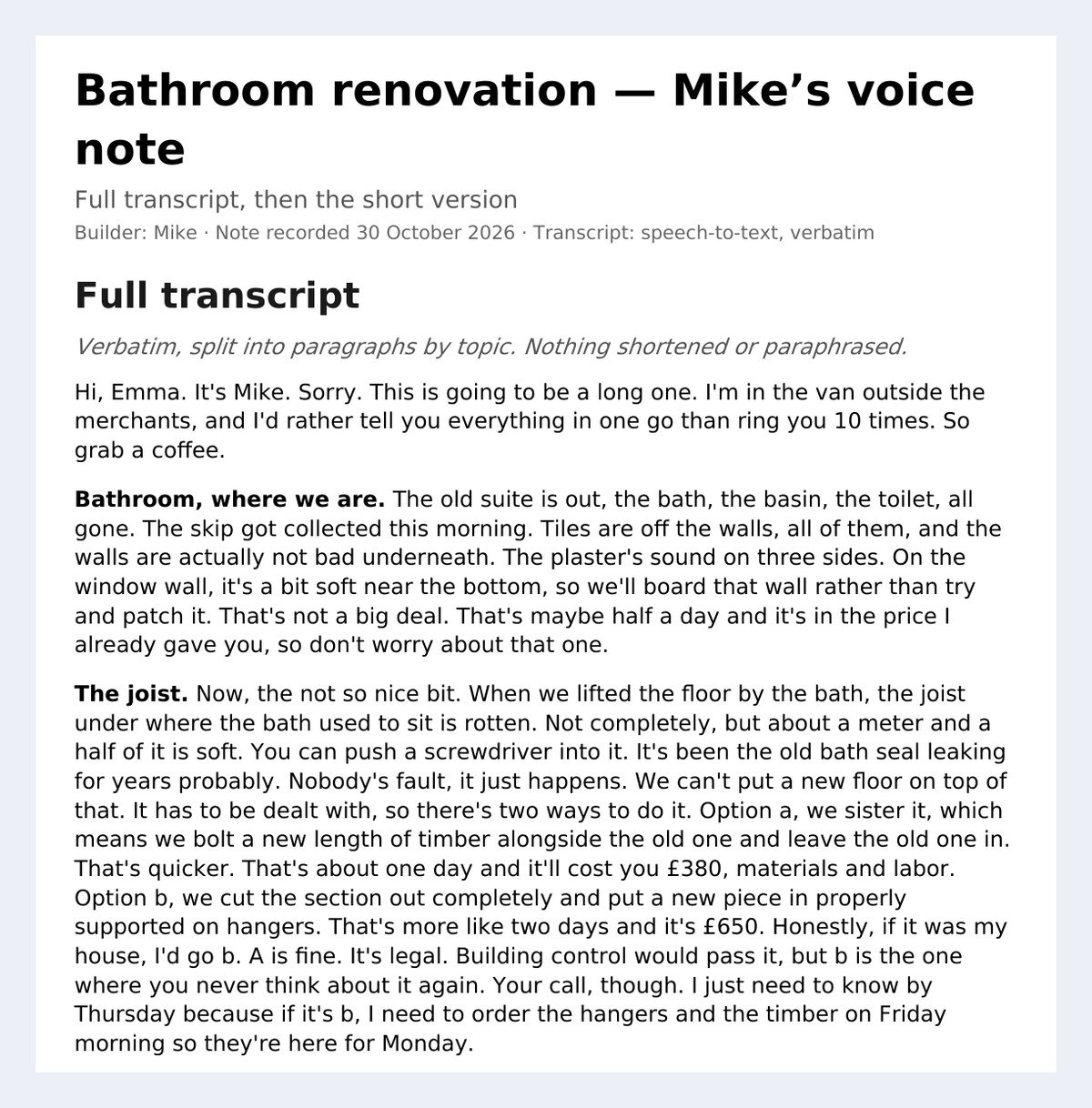
What ten minutes of audio turned into
Five messages and a little over three minutes of waiting in total gave Emma:
- the full text of a ten-minute voice note, word for word, split into labelled topics;
- a list of the spots the transcriber may have misheard, so she knows what to double-check;
- a short version with six decisions, prices and deadlines, plus the three things the builder forgot to repeat;
- an exact quote about the joist and the plumber's number as digits;
- a reply that answers all eight questions in one message;
- a Word file with the transcript and the summary, ready to keep with the quote.
Which recordings you can send
The same chat handles more than voice notes. The agent transcribes three kinds of audio automatically:
- Voice messages, your own or forwarded from anyone: a client, a colleague, a family chat.
- Audio files: a recorded interview, a call recording, a podcast episode, a dictaphone memo.
- The soundtrack of a video: a screen recording with narration, a webinar clip, a video message.
What you ask for next depends on the recording. For an interview, the full text and quotes. For a lecture, notes and questions; we tested that in AI note taker for lectures: send the recording, get notes and questions to test yourself. For a team call, decisions with owners and dates, as in AI meeting minutes: send the recording of a team call, get decisions, owners and deadlines. And if the voice note is in a language you don't speak, ask for the transcript and a translation in one message, as we did in AI translator in Telegram: a menu photo, a voice note and a PDF, translated in one chat.
Habits for a transcript you can rely on
The agent does the listening, the typing and the sorting. A few habits on your side make the text solid enough to act on.
Ask for the full text first, the summary second. A summary is only as good as what it was made from. With the transcript in the chat, you can check any line of the summary against what was actually said.
Treat numbers and names as the parts to double-check. Speech-to-text hears sounds, and “five hundred one” can become 501. Ask: “List any numbers, names or dates that may be misheard.” In our test the agent did it unprompted: the radiator width, the shower screen and the phone number.
Give context in one line. “From my builder, about the bathroom renovation” helps the agent label the topics and read “sister it” as carpentry, not family. If you know names that will come up, mention them.
Ask for quotes when it's about money or promises. “Quote him word for word” returns the speaker's sentence, not a paraphrase. That is what you want before you agree to £650.
Keep long recordings in one chat. Each follow-up uses the transcript already in the conversation, so you don't pay to transcribe twice. Ask everything you need in the same thread, then start a new one with /clear when you move on.
What it costs
We read the balance in the agent's status line after each message. The transcript cost 14 : transcription is 1 per minute of audio, so about 10 went to the ten minutes of speech and the rest to writing out 1,800 words. The short version cost 2 , the quote 2 , the reply 1 and the Word file 6 . That is 25 for the whole case.
The Free plan gives 200 in the first month and 100 every month after, with no card. Voice, files and memory are on from the start. Pro costs $13.90 a month for 400 , or $1.39 for the first month if you subscribe within 7 days of signing up, and adds recurring reminders and scheduled tasks. The rate per minute of audio is the same on both plans. All rates are on the Pricing page.
Your recordings stay in your agent's isolated container. Transcription runs on Deepgram Nova-3. To work with the text, the agent sends requests to the model: on the default model they go through DeepSeek's infrastructure in the People's Republic of China, which you confirm during onboarding, and on Pro you can attach your own Claude or Codex, so requests go to that provider under your own account.
Messages worth copying
Transcribe this voice note word for word, all of it, split into paragraphs by topic. No summary yet.
List any numbers, names or dates in the transcript that may be misheard, with what was most likely said.
Now the short version: what's done, what changed, every decision I need to make with the deadline, and the money.
What exactly did they say about [topic]? Quote word for word.
Put the full transcript and the short version into one Word file and send it here.
Create your agent and forward it the longest voice note in your Telegram.
Try it with your own agent
Free, no card. The agent starts working in the chat straight away.
Create your AI agentQuestions
How do I turn a Telegram voice message into text?
Forward the voice message to your AI agent and add one line: “Transcribe it word for word, split into paragraphs by topic.” The agent transcribes voice automatically. In our test a voice note of almost ten minutes came back as full text in 47 seconds, in three messages because Telegram limits the length of one message.
Is the transcript really word for word?
Yes, it keeps the speaker's own words, including the “Sorry, I'm going on a bit”. The agent only adds paragraph breaks and short topic labels like “The joist” or “Money”. Speech-to-text can mishear a number now and then, so in our test the agent marked the spots worth a second listen right under the transcript.
Can it transcribe audio files, not only voice notes?
Yes. Voice notes, audio files and the soundtrack of a video are transcribed the same way. Send the file into the chat with your agent and say what you need: the full text, a summary or both.
What if I only need the important part?
Ask for it. After the transcript we asked for a short version with what's done, what changed, the decisions with deadlines and the money. Another message pulled out a word-for-word quote about one topic. The full text stays in the chat, so you can ask about any part of it later.
Can I get the transcript as a file?
Yes. We asked for the transcript and the short version in one Word file, and the agent sent a six-page .docx into the chat: a title, the transcript by topic, a note on unclear spots and the short version on a new page.
How much does it cost?
Transcription costs 1 per minute of audio. Our whole case, ten minutes of audio plus four follow-up requests and a Word file, cost 25 . The Free plan gives 200 in the first month and 100 every month after, with no card.