Chat case
AI translator in Telegram: a menu photo, a voice note and a PDF, translated in one chat

Abroad, the text you need to understand rarely arrives as text. It is a menu on the table, a voice message from your host, a PDF of house rules. We gave all three to our test agent in Portuguese, in one Telegram chat. It translated the menu and flagged the dishes to skip, wrote out the voice note in English, and sent the house rules back as a PDF in the same layout. Below are the real replies, the timings and what it cost.
The short answer
Send the agent what you have, as it is: a photo of the menu, the voice note your host sent, the PDF from the booking. Add one line: what it is, which language you want back and what you need to know. The agent reads the photo, transcribes the voice note and opens the file itself, then answers in your language.
The useful part is the second half of the request. “Translate this” gets you a translation. “Translate this, I don't eat pork” gets you a translation plus the three dishes to skip. And if you need a file to pass on, ask for one: a PDF in the same layout comes back in the same chat.
For questions about long documents, summaries and quotes, see Twelve things to ask an AI about a PDF. This guide is about translation.
The test: three days in Lisbon, three things in Portuguese
We made up a short trip. Our traveller has a rented flat in Lisbon, speaks no Portuguese and does not eat pork. In the first hours she runs into the three formats a translator has to handle abroad:
- a printed menu at a restaurant, sent as a phone photo;
- a 41-second voice message from the host about the keys and the flat;
- a one-page PDF of house rules, which she wants to forward to her friends in their language.
We wrote the menu, the voice note and the rules ourselves, so no real restaurant or host is involved. The answers are real: everything below was sent to our test agent on 30 October 2026, on the default model. We ran the same three requests in English, Russian, Turkish and Arabic, so each version of this article shows the replies in its own language.
Step 1. A photo of the menu
The photo is the easiest thing to send and the hardest to read with a dictionary: dish names are idioms, and the descriptions are short. We photographed the menu on the table, the way you would at a restaurant.
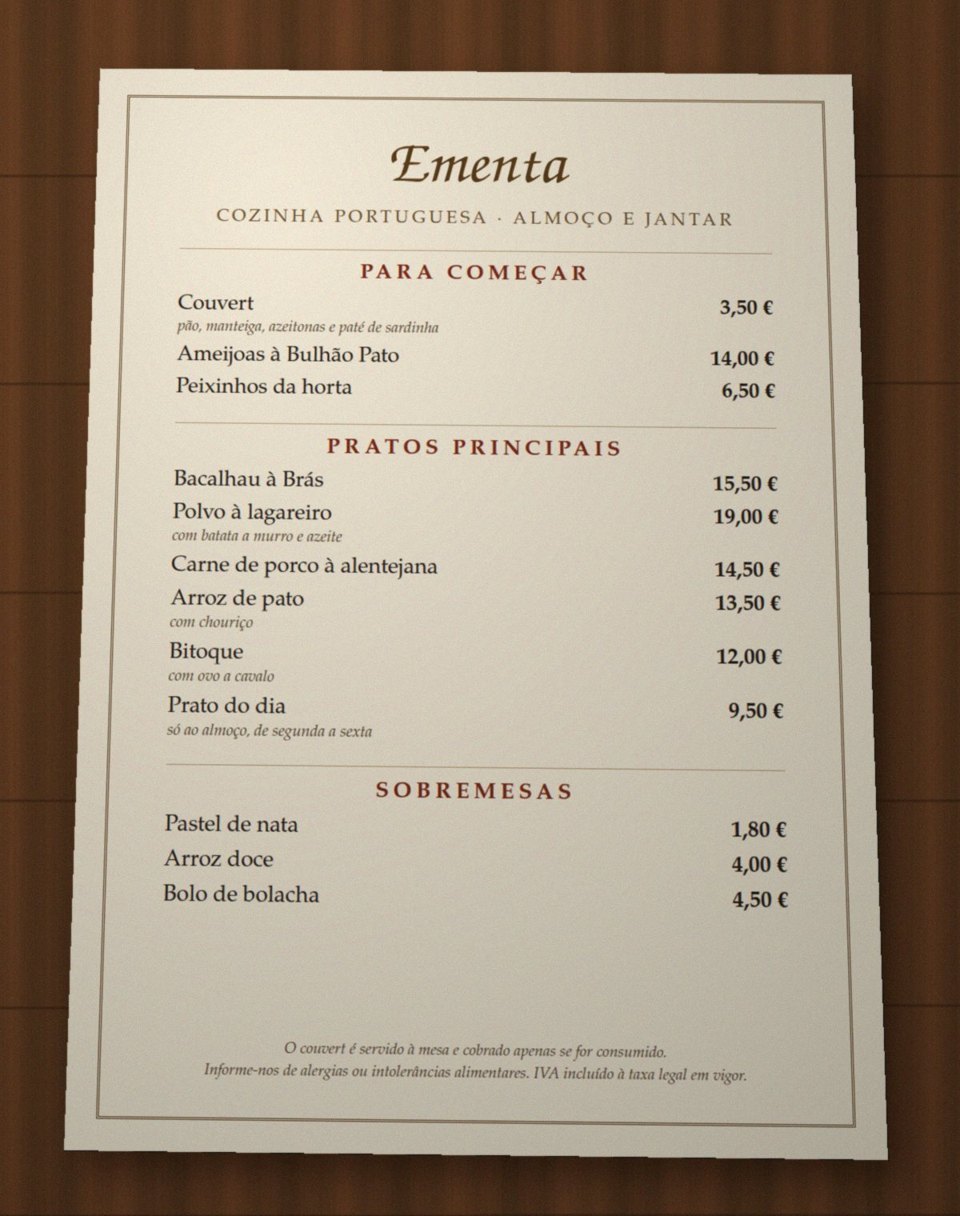
The reply came in 22 seconds. Every line of the menu is there with its price, and each dish has a short explanation rather than a word-for-word rendering: “peixinhos da horta” literally means “little garden fish”, and the agent added that there is no fish in it.
The second half of the request did the real work. The agent found pork in three places, and only one of them says “porco”. The chouriço is mentioned in small print under the duck rice, and the presunto in a bitoque is not on the menu at all: it is a habit of local kitchens, so the agent suggested one question to the waiter instead of a guess.
It also read the small print at the bottom. The couvert, the bread and olives that arrive before you order, is paid only if you eat it, and VAT is included in the prices. Those are the two things a visitor usually learns from the bill.
Step 2. A voice note from the host
Hosts, landlords and couriers often send voice messages. A voice note does not paste into a text box, and with your hands full of bags you may not even get to play it. In Telegram you forward it to the agent with a comment, and the comment goes first.
The translation arrived about two minutes after the voice note. The agent transcribed the Portuguese, translated it in full and kept the host's own words in quotes, so you can tell her message apart from its comments. The door code came through digit by digit, the way Teresa said it.
Then come two notes for the trip itself: take the stairs with luggage and plan Sunday morning around an 11:00 check-out. The voice note had eight separate facts in 41 seconds. Written down, they are easy to find again on Sunday morning.
If you want to answer the host in Portuguese, ask in the same chat: “Write a short reply in Portuguese: thank you, we arrive at 6 pm.” The agent can also prepare you to say it out loud. That is a different skill, covered in Speaking practice with AI: a 10-minute voice routine in Telegram.
Step 3. House rules as a PDF, back as a PDF
The third item is a document you will not keep to yourself. The friends you travel with need the rules too, and a wall of text in a chat is easy to lose. So the request asks for a file in the same layout as the original.
The file came back in six minutes. On the left is the page we sent, on the right the page the agent returned.
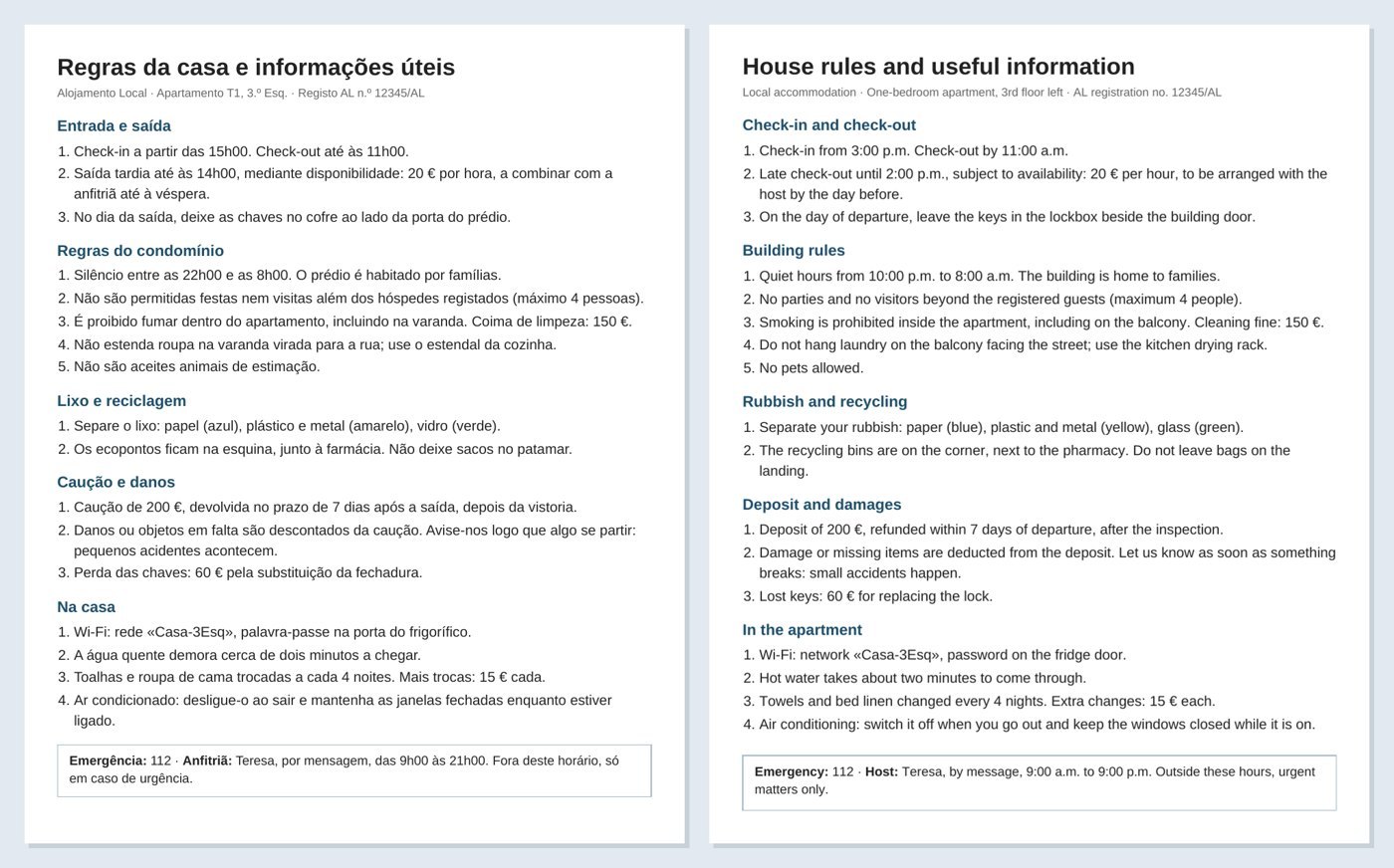
The layout survived: five sections with coloured headings, numbered lists, the grey line with the registration number and the bordered box at the bottom. The text in the PDF is live, so your friends can copy the Wi-Fi name or search for “deposit”.
Two choices show care for the reader. Times became “3:00 p.m.” and “10:00 p.m.” in English, while the Russian and Turkish versions kept the 24-hour clock. And the Wi-Fi network name stayed exactly as written, because that is what appears on the phone screen. In the agent's reply, the fees are pulled out into one line, so you can see what costs money before you forward the file.
What one chat gave us
Three formats, three translations and one place to find them again:
- a full menu translation with prices, three dishes to skip and two notes on how a Lisbon bill works;
- the host's voice note as text, with the door code and the check-out time;
- the house rules as a one-page PDF in the original layout, ready to forward.
Nothing had to be retyped or copied between apps. The photo, the voice note and the file went into the same chat where you already talk to the agent, and the answers came back there.
We also checked the other languages. The same requests in Russian, Turkish and Arabic came back in those languages, and the house rules came back as PDFs in each of them.
How to get a better translation
Say what the translation is for. “I don't eat pork” turned a list of dishes into a decision. The same works elsewhere: “I'm allergic to nuts”, “we arrive after 11 pm”, “I need to know what I'm agreeing to”.
Give a photo the agent can read. Hold the phone flat over the page, fit the whole menu in the frame and avoid glare from a lamp. Two pages are two photos.
Forward voice notes with one line of context. “My host sent this” tells the agent who is speaking and what matters. Without it, a voice note in a foreign language is just a voice note.
Ask for the format you will use. A PDF to forward, a Word file to edit, plain text in the chat to read on the go. Name the people who will read it if that changes the language or the tone.
Double-check numbers you will act on. Door codes, times, amounts: the agent writes them out, so a glance at the original takes a second. When a recording is noisy, ask the host to confirm the time in writing.
Keep the trip in one chat. The agent remembers what you sent earlier in the conversation, so “reply to Teresa in Portuguese” works without explaining who Teresa is.
What stays with you
Your chat, with the photos, voice notes and files you send, stays in your agent's isolated container. To answer, the agent sends requests to the model: on the default model they go through DeepSeek's infrastructure in the People's Republic of China, which you confirm during onboarding, and on Pro you can attach your own Claude or Codex. Voice transcription runs on a separate service whatever the model. If a document contains personal data, such as a passport scan or a contract, keep that in mind before you send it.
What it costs
We read the balance in the agent's status line before and after each request. The menu photo cost about 5 , the voice note about 3 and the PDF with a file back 5 . That is about 13 for the three translations.
The rates behind it: a photo or screenshot read costs 1.5 , transcribing a voice message costs 1 a minute, and text on the default model costs 1 per 20,000 tokens. The Free plan gives 200 in the first month and 100 every month after, with no card. Pro costs $13.90 a month for 400 , or $1.39 for the first month if you subscribe within 7 days of signing up. All rates are on the pricing page.
Messages worth copying
Translate this menu into English. I don't eat pork: tell me which dishes to skip and what to ask the waiter.
My host sent this voice message. What does she say? Translate it into English and list anything I need to do.
Translate this document into English and send it back as a PDF with the same layout.
Write a short, polite reply to her in Portuguese: thank you, we arrive at 6 pm.
What does this sign say, and does it matter for me?
Create your agent before the trip and send it the first thing written in a language you don't read.
Try it with your own agent
Free, no card. The agent starts working in the chat straight away.
Create your AI agentQuestions
Can an AI agent translate text from a photo?
Yes. Send the photo of a menu, a sign or a screenshot and say which language you want. In our test the agent read a full Portuguese menu from a phone photo and translated every line with prices in 22 seconds.
Can it translate a voice message?
Forward the voice note to the agent with one line of context. Voice is transcribed automatically, and the agent replies with the translation in your language. Our 41-second voice note in Portuguese came back in English about two minutes later.
Can it translate a PDF and send a file back?
Yes. Ask for the format you need. We asked for a PDF with the same layout, and the agent sent back a one-page PDF with the same headings, numbered lists and the box at the bottom, with live text you can copy.
Which languages does it translate?
We tested Portuguese into English, Russian, Turkish and Arabic, the four languages of this site. The agent answers in the language you write in, so you can simply ask in your own language and name the language you want back.
Is an AI translation good enough for official documents?
For understanding a document and sharing it with friends, yes. For anything you submit to an authority, a court or a bank, use a certified translator: they sign the translation and take responsibility for it.
How much does it cost?
Our three translations cost about 13 in total. The Free plan gives 200 in the first month and 100 every month after, with no card.